
Let’s Dive into a Hot Topic in the Sales World: AI Agents
Did you know that most sales reps spend only about 28% of their time actually selling? That means a staggering 72% goes to administrative tasks and busywork that doesn’t contribute directly to revenue.
Crazy, right?
This inefficiency is prompting sales teams to turn to AI agents—smart tools designed to handle all the tedious tasks and free up valuable time.
Understanding AI Agents for Sales
With AI handling the grunt work, sales professionals can focus on what they love—connecting with customers and closing deals. Let’s explore how AI sales agents are revolutionizing sales teams everywhere!
An AI sales agent is like that sharp, tech-savvy buddy who always has your back on the sales battleground. Imagine a virtual sidekick handling the mundane tasks while you focus on what you do best—selling and building relationships.
What AI Sales Agents Can Do:
- Lead Sherlock: AI agents analyze vast amounts of data to identify high-potential leads, eliminating the guesswork in prospecting.
- Data Whiz: Say goodbye to drowning in spreadsheets—your AI agent organizes customer data efficiently.
- Chatbot Assistant: AI agents answer customer queries and send automated follow-ups, ensuring seamless communication.
- Scheduling Ninja: No more back-and-forth emails—your AI agent schedules meetings instantly.
- Insight Genie: AI analyzes your sales performance and offers data-driven insights to refine your strategy.
In short, AI sales agents act as super-efficient assistants—always available, never tired, and focused on helping you hit your sales targets!
Types of AI Sales Agents
AI sales agents fall into two primary categories, each catering to different sales processes.
1. Autonomous AI Agents
Autonomous agents operate independently, using data, workflows, and smart algorithms to execute tasks without human intervention.
Example:
An SDR AI agent can handle incoming leads through emails and chat, responding instantly and even scheduling meetings for the sales team.
2. Support AI Agents
Support agents work alongside human sales reps, assisting them in various tasks while using real-time reasoning.
Example:
An AI coaching agent can simulate sales conversations, provide feedback, and improve sales competency—just like a personal sales life coach!
AI sales agents analyze insights, create strategies, and execute decisions using advanced algorithms and decision trees.
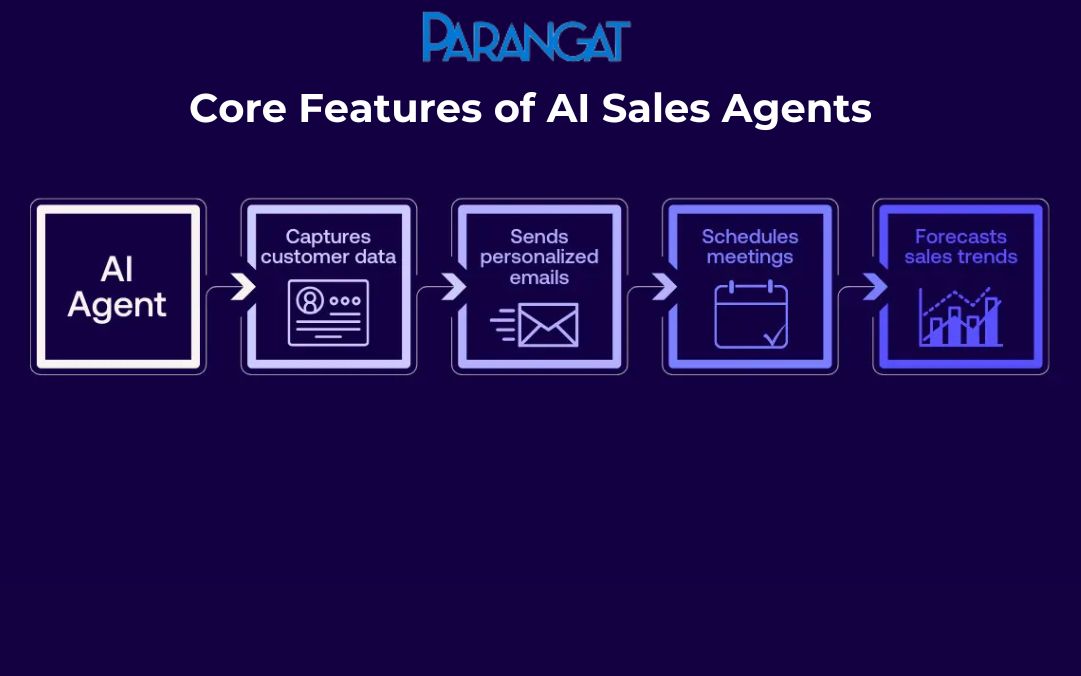
Both types of AI sales agents share common features that enhance efficiency and productivity:
1. Data-Driven
AI agents require high-quality CRM and business data to provide accurate, personalized responses.
2. Always Available
Autonomous AI agents operate 24/7, ensuring no leads slip through the cracks.
3. Highly Customizable
Businesses can tailor AI agents through low-code platforms, workflows, and APIs, ensuring seamless integration.
4. Secure and Compliant
AI sales agents adhere to data protection regulations and maintain high security standards. Learn more about AI and compliance here.
5. Scalable
AI sales agents can handle high volumes of tasks with minimal human intervention.
6. Seamlessly Integrated
AI sales agents work effortlessly with CRM and sales force automation tools, enhancing team collaboration and efficiency.
Use Cases for AI Sales Agents
AI sales agents are revolutionizing sales processes across industries. Here are real-world applications:
1. Lead Generation
Example: AI agents identify and qualify leads from social media, forums, and web analytics, ensuring sales teams focus on high-value prospects.
2. Personalized Customer Engagement
Example: An AI agent at an online clothing store recommends products based on past browsing behavior.
3. Scheduling and Follow-Ups
Example: AI agents automate appointment scheduling and reminders for service-based businesses.
4. Sales Coaching and Training
Example: AI agents simulate customer interactions to enhance sales reps’ pitch and upselling techniques.
5. Data Analysis and Insights
Example: AI agents analyze customer behavior trends, enabling businesses to refine sales strategies.
6. Automating Administrative Tasks
Example: AI agents handle data entry and CRM updates, saving real estate agencies hours of work.
7. 24/7 Customer Support
Example: AI chatbots assist customers in placing orders, resolving issues, and providing product recommendations. Check out an example of AI in customer service.
How AI Sales Agents Work: Setup and Deployment
Step 1: Identify Your Needs
Define goals such as lead generation, customer engagement, or follow-ups.
Step 2: Choose the Right AI Platform
Select an AI solution like Salesforce, HubSpot, or Drift that aligns with your sales strategy.
Step 3: Gather Quality Data
Ensure CRM data, customer interactions, and analytics are clean and well-organized.
Step 4: Configure the AI Agent
Set up workflows, engagement triggers, and automation rules.
Step 5: Train the AI
Feed training data and continuously refine AI responses using machine learning.
Step 6: Integrate with Existing Tools
Connect the AI agent to your CRM, email, and messaging platforms for seamless operations.
Step 7: Test and Optimize
Simulate interactions and adjust workflows based on feedback.
Step 8: Deploy and Monitor
Launch the AI agent and track engagement, conversion rates, and overall performance.
Step 9: Continuous Improvement
Implement feedback loops to enhance AI capabilities over time.
Conclusion
AI sales agents revolutionize sales processes by automating tasks like lead qualification, follow-ups, and data analysis. They offer 24/7 availability, seamless CRM integration, and customization options to fit any business’s needs.
By implementing AI sales agents, businesses can boost productivity, increase revenue, and improve customer satisfaction.
Related Read:
Check out Parangat’s blog for more insights into AI and sales automation.